The Continuity Program at San Francisco State University is dedicated to ensuring the resilience and uninterrupted operation of the University’s critical functions in the face of disruptions. Our mission is to safeguard the well-being of our students, faculty, staff, and community by proactively identifying risks, developing comprehensive preparedness plans, and fostering a culture of resilience. Through collaboration, innovation, and continuous improvement, we strive to minimize the impact of emergencies, maintain academic and operational continuity, and support the University’s commitment to excellence in education, research, and service. Together, we build a stronger, more resilient SFSU, ready to adapt and thrive in an ever-changing world.
What is Continuity?
Continuity refers to the ability of an organization to continue its critical functions during and after disruptions. Critical functions for San Francisco State University include a variety of things, including, but not limited to, academic instruction, research, housing for residential students, and financial operations.
Continuity helps us prepare for a wide range of events, from those affecting a single person, department, or building to those impacting the entire San Francisco Bay region.
Campus Continuity Resources
Documents and Guides
Kuali Ready
San Francisco State University has adopted Kuali Ready as a tool to help departments and business units develop their continuity plans and facilitate regular review of existing plans.
If you are ready to get your department plan started, please contact JLP Prince at jlp.prince@sfsu.edu
Continuity Frequently Asked Questions
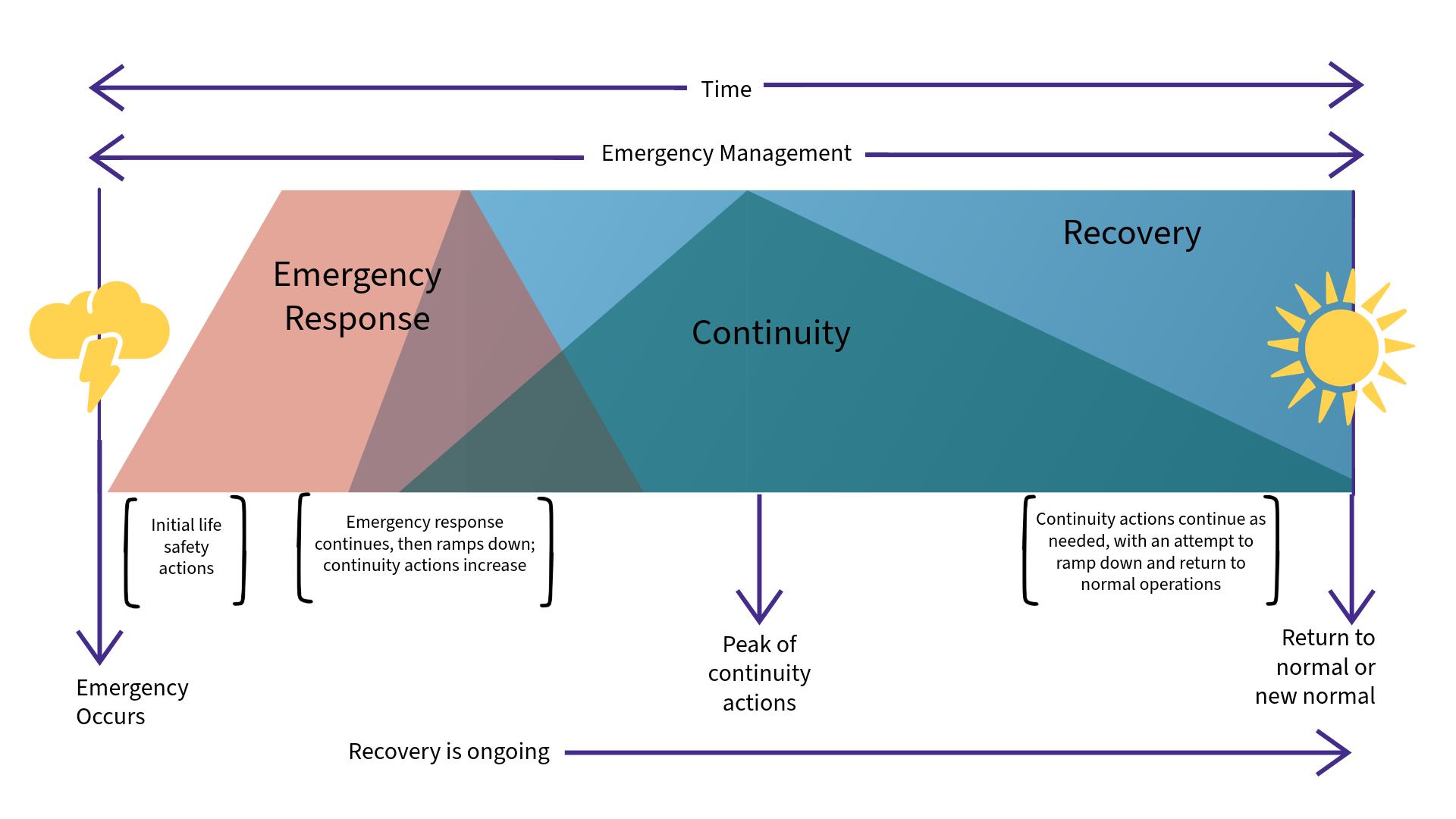
Continuity is the ability of an organization to continue operations and services in the face of a disruptive event. Planning is about understanding, anticipating, and planning for events that threaten the mission and operations of San Francisco State University. Continuity is more than just the ability to recover from a disaster; it’s the ability to continue operating during and after any incident. Incidents can be small (such as staff member absences) or large (such as a large earthquake).
Emergency Management includes all parts of the emergency cycle – mitigation, preparedness, response, and recovery. Continuity is a small part of all of these and focuses on continuing teaching, research, and other mission-critical functions despite the emergency, whenever possible.
- Planning Personnel: Who in your department is responsible for coordinating the planning process?
- Identifying Departmental Functions: What are your department’s primary functions and who is responsible for keeping this updated?
- Describing Departmental Functions: Determine their priority, how long the University could operate without this function, who depends on this function being performed, and what functions your department depends on others completing.
- Delegation of Authority: What is the line of authority in your department and what limitations on delegation exist?
- Facilities: Identify all of your department’s facilities and determine which critical functions require specific facilities. This is vitally important if you need to temporarily move operations to another location.
- Personnel and Function: What critical functions do your staff perform? Does only one person know how to do that function? Are there any special skills, licenses, or permissions needed to complete the function? Is telecommuting or online courses a possibility?
- Records Management: What records does your department manage? Where and how are they kept? Who is responsible for their update and/or back up?
- Communications: Determine how everyone in your department will communicate. Include various ways to plan for a variety of disruptions and include times for business hours and off hours.
- Service Providers: What services do you currently have that are provided by an outside contractor? How will these services be continued during a disaster and are alternatives available?
- Notifications: If you have to activate your continuity plan and modify your operations, who needs to be notified and how do you notify them?
Your continuity plan can never be complete – there are too many unknowns between hazard type, timing, and scale to plan for everything. The Kuali Ready form will prompt you for the appropriate level of detail, and most of these details will be things that you (or someone in your department) should easily know or be able to figure out. Be Brief: Most questions are best answered with one or two sentences or several bullets.
Your continuity plan should be implemented whenever there is an interruption to how you normally operate, whether it is an emergency or planned change. It can be used for something as regular as a staff member taking a planned (or unplanned!) Leave of Absence or FMLA or bigger, unexpected emergencies. Please note that your departmental continuity plan is a separate document from the campus Emergency Operations Plan.
It could be something catastrophic (such as an earthquake, pandemic, or act of violence on or near campus) or something small (such as a staff absence or a power or water outage affecting only your building). The plan kicks in whenever you are unable to continue doing your job and the functions you have deemed critical in your usual way.
A departmental function may be defined as a collection of activities normally performed by your unit. In continuity planning, we focus on essential functions that must be resumed within 30 days or sooner of a disrupting event.
A departmental function enables the campus to maintain its essential functions. San Francisco State University’s essential functions are:
- Organizational Leadership – Ensure the continued functioning of visible executive leadership of SFSU for decision making and strategic guidance even during disruptive events, ensuring legal and regulatory compliance, communicating with internal and external stakeholders, and mitigating reputational impacts.
- Community Safety – Support and promote a safe and secure university community to ensure scholastic success on all campuses. Protect lives, property, and environment across SFSU by responding to emergencies and mitigating against potential threats and hazards.
- Teaching & Learning – Maintain the capacity for quality teaching and learning at SFSU even during disruptive events.
- Critical Infrastructure – Preserve and protect infrastructure necessary of SFSU campuses, including facilities, roads, pathways, utilities, communication systems, information technology systems, as well as personnel needed for operation and maintenance. Infrastructure must be maintained in a way that prioritizes accessibility for the campus community.
- Financial & Administrative – Ensure the financial stability of SFSU operations by mitigating revenue loss, strategic allocation of resources during emergencies, & continued payroll and procurement operations. Maintain support for SFSU employee services, such as human resources, workers compensation, and other operations.
- Residential Services – Coordinate care and support for the residential communities of SFSU when normal operations are disrupted. Care and support includes, but is not limited to, shelter, food services, water, hygiene, etc.
- Academic Operations – Continue academic operations beyond instruction. This includes, but is not limited to, research, library services, registrar services, and admissions, which advance the educational mission of SFSU.
- Campus Services – Continue non-residential services for students and employees that support academic instruction and operations. This includes, but is not limited to, health center, counseling and psychological services, resource centers, academic advising, and financial aid.
Processes are the steps needed to accomplish a function or task. These are important to document and include in continuity plans, but under the umbrella of the function. For example, the departmental function to provide meals for residents of university housing is accomplished through the processes of purchasing food, food storage, cooking, serving and cleaning. In continuity planning we focus on identifying prioritized essential functions, and then provide supporting documents that describe the process (the who, what, when and how the task is performed
Levels of Criticality:
- Critical 1 – Cannot Pause: Necessary to life, health, and safety. Must be continued at normal or increased service load.
- Possible examples: police dispatch, door access, research sample storage, food service for residential students
- Critical 2 – Resume within 24 Hours: Failure will lead to imminent and very serious consequences. Must continue, if at all possible, perhaps in a reduced mode.
- Possible examples: Data networks, email system, instruction by faculty
- Critical 3 – Resume within 24 hours –7 days: Important to core operations. Extended outage will disrupt key services or compliance obligations but does not pose immediate threat to life, health, or safety.
- Possible examples: financial systems, payroll systems, student information systems
- Critical 4 – Resume within 7–30 days: Necessary for long-term continuity but not for short-term operations. Prolonged suspension may cause minor financial, regulatory, or reputational impacts.
- Possible examples: research (project dependent, excludes animal care), OneCard Services, health maintenance appointments
- Deferrable – Can pause: Non-essential during continuity events. Functions may be suspended until normal operations resume with little to no impact on organizational objectives.
- Possible examples: research help desk, events, recreation, orientations
Your department’s continuity plan is not a test – there are no wrong answers. Complete a ranking to the best of your ability, and
The methodology that we employ for continuity planning mostly avoids discussions of particular events and is an “all-hazards” approach. All disrupting events will affect our ability to function in similar ways: the circumstances will temporarily prevent us from using some of the resources to which we have become accustomed.
These resources include:
- Space (classrooms, labs, studios, meeting spaces, and offices)
- People (faculty, staff, students, and external partners)
- Equipment (computers, networks, and other equipment)
- Information (libraries, databases)
- Funds (grants, tuition and fees, state and federal funding, donations, etc.)
Our planning focuses on:
- Identifying the resources that are critical
- Safeguarding critical resources against loss (such as backups of systems & data, bracing of equipment, safe storage of research items)
- Actions that will lessen the impact of losses (such as pre-arrangements with sibling campuses for mutual aid)
- Replacing resources quickly (such as contracts with vendors)
- Performing critical functions without some of those resources (such as teaching via distance learning technology)
- Providing our people with the information they will need post-disaster to resume campus activities
- Documenting plans to ensure we can maintain performance of critical functions.
Continuity Governance at SFSU
The University President and senior leadership provide strategic direction and support for the Continuity Program, ensuring it aligns with the institution’s mission, values, and priorities. The President’s Cabinet serves as the ultimate decision-making body for continuity-related policies and resource allocation based upon the recommendations of the Continuity Planning Committee.
The Campus Continuity Coordinator is responsible for establishing and maintaining the campus continuity program. They coordinate with the Campus Planning Committee for additional input and to obtain support in maintaining department planning and preparedness. Additionally, they work with campus business and academic units’ senior leaders and continuity leads to support implementation within units.
Pursuant with CSU Executive Order 1014 (CSU System Continuity Program), the Continuity Planning Committee includes a cross-section of senior administrative leaders who have a working knowledge of continuity processes and are from business units responsible for emergency response and high-priority essential functions. The Campus Continuity Coordinator serves as the convener and facilitator of this group.
Each Department or Business Unit (as determined by the cabinet area VP) should have at least one staff member who serves as a liaison to the Continuity Program. This individual is responsible for, in conjunction with the Campus Continuity Coordinator, developing and submitting the continuity plan for their area and reviewing, and if necessary, revising the plan annually. They are also responsible for notifying the Campus Continuity Coordinator if a plan is activated as soon as possible following a disrupting incident.